India’s labour market is one of the largest and most dynamic in the world. Every year millions of graduates enter the workforce while companies struggle to identify candidates with the right skills. Traditional hiring methods—manual resume screening, repetitive interviews, and subjective assessments—are increasingly inefficient in a digital economy. Artificial Intelligence (AI) is now emerging as a transformative force that is reshaping how recruitment happens in India.
Across sectors such as IT, e-commerce, consulting, and manufacturing, organisations are adopting AI-driven hiring platforms to manage large applicant pools and identify talent more accurately. These systems analyse resumes, evaluate skills, automate interview scheduling, and even predict a candidate’s future performance. The result is a recruitment process that is faster, more scalable, and significantly more data-driven.
Why AI Adoption in Recruitment Is Accelerating in India
India’s rapidly digitising economy has created demand for specialised skills in areas such as data science, cloud computing, cybersecurity, and artificial intelligence itself. At the same time, companies receive thousands of applications for a single role. AI helps recruiters navigate this complexity by automatically identifying candidates with relevant skills and experience.
- Large applicant volumes requiring faster screening
- Growing demand for specialised technical skills
- Pressure to reduce hiring time and cost
- Need for better candidate experience and communication
- Increasing reliance on data-driven decision making
These factors have pushed HR teams to adopt intelligent recruitment platforms that combine machine learning, natural language processing, and predictive analytics to assist hiring decisions.
How AI Is Changing the Recruitment Process
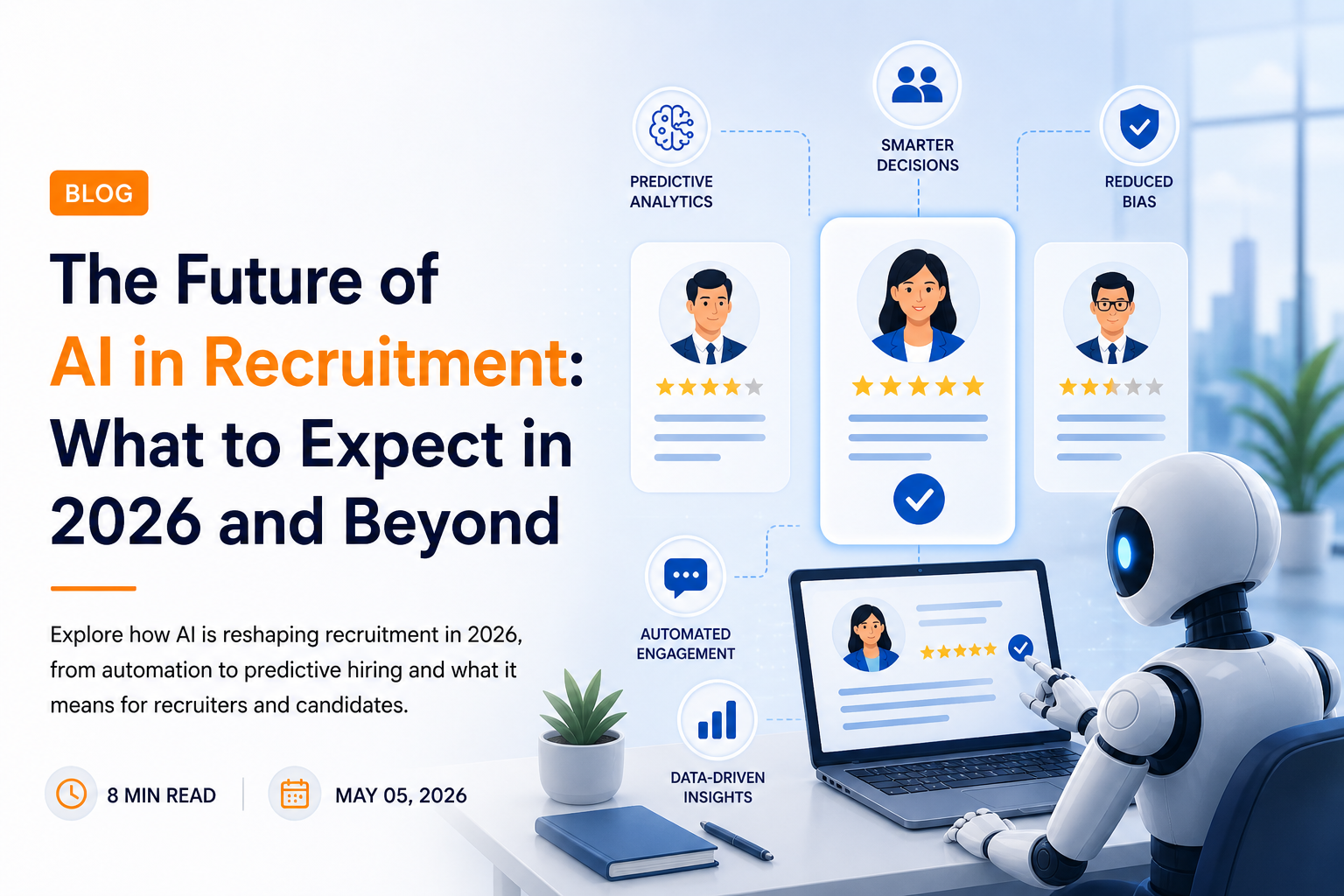
AI is transforming multiple stages of the hiring lifecycle. Instead of being limited to resume filtering, modern recruitment AI platforms influence sourcing, assessment, interviews, and candidate engagement.
- Automated resume screening using natural language processing
- AI chatbots that answer candidate questions and schedule interviews
- Skill-based assessments and coding challenges evaluated automatically
- Video interview analysis that evaluates communication and responses
- Predictive analytics that forecast candidate success and retention
These tools allow recruiters to focus more on meaningful conversations with candidates rather than administrative tasks. For high-growth companies and startups, this shift dramatically improves hiring speed.
Benefits for Employers and Candidates
AI-driven recruitment platforms provide significant advantages for both organisations and job seekers. For employers, they reduce time-to-hire and improve the quality of candidate selection. For candidates, they often lead to a faster and more transparent hiring experience.
- Faster screening of thousands of applications
- Improved accuracy in matching candidates to roles
- Reduced unconscious bias when designed responsibly
- Better candidate communication through automation
- Data-driven insights into hiring performance
In India’s competitive job market, these advantages can help organisations build stronger teams while giving candidates a fair opportunity to demonstrate their skills.
The Rise of AI-Powered Assessments
One of the most significant shifts in recruitment is the move from resume-based evaluation to skill-based assessment. AI platforms now test candidates using coding challenges, cognitive games, behavioural analysis, and structured interviews. These assessments allow companies to identify talent that might otherwise be overlooked due to non-traditional backgrounds or limited work experience.
For fresh graduates in India, this change is particularly important. Instead of relying solely on academic pedigree or college reputation, employers increasingly evaluate candidates based on practical skills and problem-solving ability.
Challenges and Ethical Concerns
Despite its advantages, AI recruitment also raises critical ethical questions. Algorithms are only as good as the data they are trained on. If historical hiring data contains bias, AI systems may unintentionally replicate those biases.
- Algorithmic bias in training data
- Lack of transparency in automated decision making
- Privacy concerns related to candidate data
- Over-reliance on automated screening
- Need for human oversight in hiring decisions
For this reason, AI should augment human recruiters rather than replace them. Responsible organisations combine AI-driven insights with human judgement to ensure fairness and transparency.
The Future of Recruitment in India
The future of hiring in India will likely be a hybrid model where AI handles large-scale data analysis while recruiters focus on strategic and human aspects of hiring. New roles such as AI ethics auditors, talent intelligence analysts, and algorithm trainers are already emerging within HR departments.
At the same time, students and professionals who understand how to work with AI tools will have a competitive advantage in the job market. Employers will increasingly look for candidates who can collaborate with intelligent systems rather than compete against them.
“The most powerful future of recruitment will not be AI replacing recruiters, but AI empowering recruiters to make better, fairer, and faster hiring decisions.
— Industry Insight
India is uniquely positioned to lead the next wave of AI-driven recruitment innovation. With its massive talent pool, thriving startup ecosystem, and rapidly digitising economy, the country is likely to see an explosion of intelligent hiring platforms that redefine how organisations discover and nurture talent.
References
Report highlighting hiring trends in India, including the rise of AI-related roles and increasing fresher hiring demand.
Article summarizing hiring trends based on the TeamLease EdTech Career Outlook Report.
Policy framework outlining ethical principles for AI systems including fairness, accountability, and transparency in automated decision-making.
Algorithmic Bias and Discrimination: Legal Accountability of AI Systems
Academic paper examining algorithmic bias and its implications for AI-driven decision systems including hiring.
Overview of AI recruitment platforms such as HireVue, HackerRank, and Pymetrics and their role in modern hiring workflows.
AI and the Future of Work in Indian IT Services
Industry analysis describing the shift from mass hiring to specialized AI-driven recruitment and skill-based hiring models.