For decades, hiring has revolved around a simple artifact: the job description.
A static document. A list of responsibilities. A checklist of “must-have” qualifications.
But here’s the uncomfortable truth: job descriptions were never designed for the world we live in today.
And now—they’re breaking.
The Problem: Job Descriptions Were Always Flawed
Traditional job descriptions assume something that is no longer true—that roles are stable.
They’re not.
The same job title can mean completely different things across companies. A “Product Manager” in one company might be a backlog manager, while in another, they’re defining long-term strategy.
This inconsistency leads to a fundamental hiring problem: we hire based on labels, not actual capability.
Even worse: job descriptions are static, work is dynamic, and skills evolve faster than roles.
Research suggests that nearly 39% of skills are expected to change by 2030, while the half-life of a skill has shrunk dramatically. A document updated once a year simply cannot keep up.
The Shift: From Roles to Skills
Forward-thinking organizations are moving away from role-based hiring toward skills-based hiring.
Instead of asking, “Has this person done this job before?”, they ask, “Can this person solve the problems this role requires?”
Skills-based hiring evaluates candidates on demonstrated abilities rather than degrees, titles, or years of experience.
And the impact is significant. LinkedIn’s Economic Graph research shows that talent pools can expand dramatically when hiring is based on skills rather than titles. It also improves access to non-traditional candidates and can strengthen diversity in hiring funnels.
This isn’t just a better hiring method. It’s a fundamentally different way of understanding work.
Enter Skills Graphs: The New Hiring Infrastructure
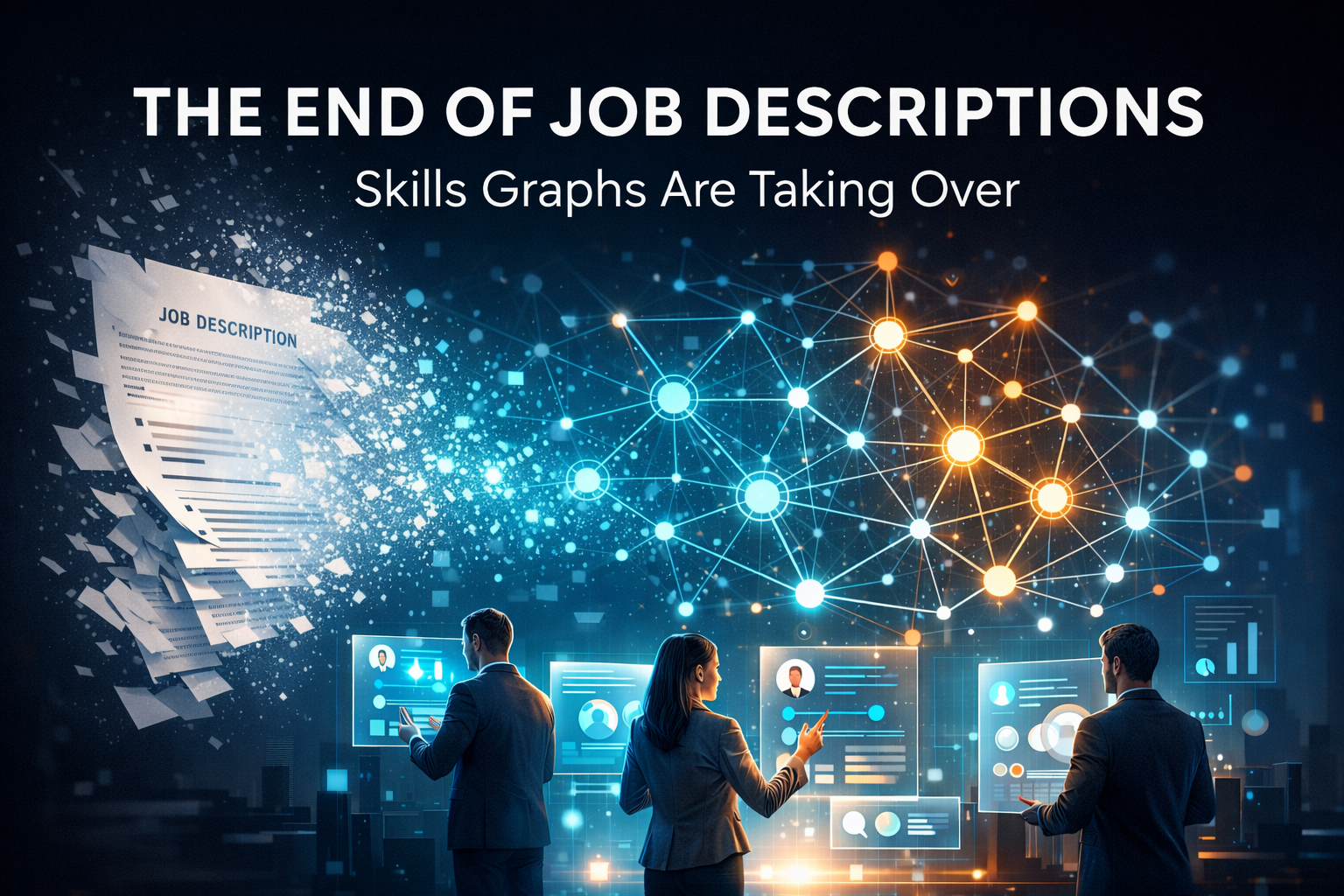
If job descriptions are static documents, skills graphs are living systems.
A skills graph maps skills to roles, skills to other skills, skills to career paths, and skills to real-time market demand.
In simple terms, it’s a dynamic network of capabilities, not a fixed list of responsibilities.
A job description tells you what a role was. A skills graph tells you what work requires right now.
Why Skills Graphs Will Replace JDs
1. Work is No Longer Linear
Careers today are not ladders—they are networks. A candidate might move from marketing to product to growth to AI operations. Job descriptions can’t capture this fluidity. Skills graphs can.
2. Hiring Needs Precision, Not Proxies
Degrees, titles, and years of experience are proxies for capability. But proxies fail. Skills graphs reduce guesswork by focusing directly on what someone can do, how well they can do it, and how transferable those skills are.
3. AI Needs Structured Data, Not Documents
AI-driven hiring systems do not perform well with vague text alone. They need structured skill data, measurable proficiency, and relationships between capabilities. Skills graphs provide exactly that.
This is why modern hiring technology is moving toward skill ontologies, talent intelligence layers, and graph-based matching engines.
4. The Talent Shortage is Often a Matching Problem
Organizations often claim they cannot find talent. But in many cases, the real problem is that they cannot recognize talent. Skills-based models reveal hidden candidates—people who may not have the “right title” but have substantial overlap with the actual requirements of the role.
5. The Future of Work is Skill-Based, Not Role-Based
Research from Harvard Business School and others shows that degree requirements are being dropped across industries, while adoption of skills-based hiring continues to rise. This is not just a trend. It is a structural shift in how companies define work and evaluate talent.
What This Means for Recruiters
Recruiters who rely only on job descriptions will struggle. Recruiters who understand skills will win.
In the near future, job descriptions will become secondary artifacts, while skills graphs will become primary hiring infrastructure. Recruiters will increasingly act more like talent analysts than resume screeners.
What This Means for Modern Hiring Platforms
This shift creates a major opportunity for hiring platforms. Imagine AI interviews mapped to skill clusters, candidates scored on skill graphs instead of resumes, and role requirements dynamically generated from market demand and internal hiring data.
That is where hiring is headed.
Final Thought: The JD Isn’t Dead—But It’s No Longer Enough
Job descriptions won’t disappear overnight. But they will lose their central role.
Because in a world where skills change faster than roles, careers are non-linear, and AI is shaping hiring decisions, a static document simply cannot compete with a dynamic system.
The future of hiring isn’t about roles. It’s about relationships between skills. And that future is already here.