Gen Z is no longer just the next wave of talent. It is already reshaping the workforce and, in the process, changing what employers must offer to attract and retain strong candidates.
By mid-2024, Gen Z had grown to about 18% of the U.S. labor force, surpassing Baby Boomers. As this cohort expands, its influence on hiring is becoming impossible to ignore. Employers are no longer competing only on salary or brand recognition. They are now being evaluated on purpose, transparency, flexibility, growth, and trust.
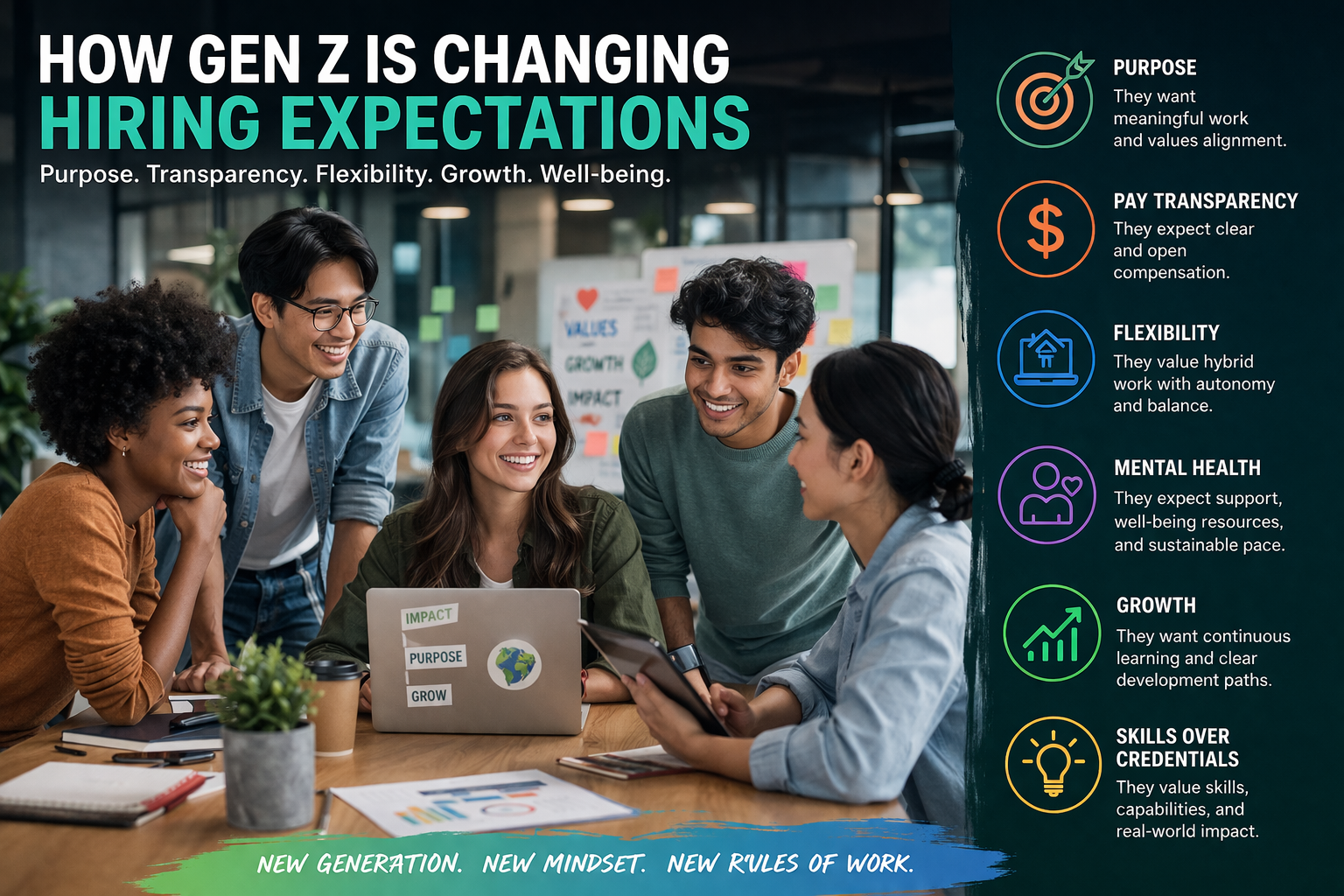
Purpose matters more than prestige
One of the clearest shifts Gen Z brings is a different definition of success. Deloitte’s 2025 Gen Z and Millennial Survey found that only 6% of Gen Z respondents said their primary career goal was to reach a leadership position. That does not reflect a lack of ambition. It reflects a broader shift in what ambition looks like.
For Gen Z, a good job is not just one that offers status. It is one that offers meaning. Around 89% of Gen Z respondents in Deloitte’s survey said purpose is important to job satisfaction and well-being. This means employers increasingly need to show not just what a role pays, but why it matters.
Hiring messages that focus only on title, hierarchy, or prestige are becoming less effective with younger candidates. Gen Z wants to understand the impact of the work, the values of the company, and whether the organization’s public stance matches its internal culture.
Growth must be visible and structured
Gen Z expects career progression, but not in a vague or delayed way. Many young professionals want clarity on what they will learn, how they will grow, and what strong performance actually leads to.
That expectation is visible in promotion data as well. A CAKE.com workforce study summarized by Elevatus reported that 70% of recent Gen Z graduates expect a promotion within their first 18 months. Randstad’s Gen Z workplace research also suggests that Gen Z employees move roles quickly in their early working years, often in pursuit of skills, growth, and long-term security rather than out of simple restlessness.
This changes how employers must hire. It is no longer enough to say there is “room to grow.” Hiring teams need to explain what growth looks like in practical terms: what the first 6 to 12 months involve, what skills will be built, how feedback is given, and what milestones lead to advancement.
Traditional management is losing appeal
Another major shift is that Gen Z does not automatically see management as the natural reward for strong work. A 2025 Robert Half survey found that 40% of Gen Z workers want a promotion that does not involve becoming a manager. Many prefer advancement as expert contributors rather than people managers.
This is important for hiring because it challenges a long-standing assumption in career design. For years, companies have treated management as the main path upward. Gen Z is pushing organizations to build alternative tracks, where employees can gain influence, pay growth, and recognition without necessarily supervising teams.
For employers, this means career architecture itself is becoming part of employer value proposition. Companies that offer dual career paths, specialist tracks, project leadership roles, and mentor-driven advancement may become more attractive to younger talent.
Flexibility still matters, but so does mentorship
Gen Z is often described as remote-first, but the evidence is more nuanced. Gallup’s 2025 research found that Gen Z workers were the least likely generation to prefer fully remote work, with only 23% of remote-capable Gen Z employees saying they preferred being fully remote.
That does not mean flexibility is unimportant. It means Gen Z often wants a blend: autonomy, yes, but also access to people, learning, and professional exposure. Many entered higher education or early internships during pandemic-era disruption, which reduced their opportunity to observe workplace norms in person. As a result, mentorship, proximity, and coaching matter more than many employers assume.
Hybrid models that are intentional, rather than arbitrary, may therefore work best. Gen Z often benefits from flexibility combined with structured in-person interaction, especially where learning by observation, feedback, and confidence-building are involved.
Mental health is now a hiring issue
Gen Z has made mental health a workplace expectation, not just a private issue. In a 2025 survey by Harmony Healthcare IT, 46% of Gen Z respondents said they had been diagnosed with a mental health condition, and 86% of working Gen Z respondents reported burnout at work. More than half said the traditional 40-hour workweek is not mentally healthy.
Whether or not every employer agrees with that framing, the hiring implication is clear: younger candidates increasingly evaluate work through the lens of sustainability. They want manageable expectations, supportive managers, flexibility, and credible wellness support.
This does not necessarily mean fewer ambitions. In fact, many Gen Z professionals remain highly driven. But they are less willing to sacrifice their health or identity for a job that feels extractive. Employers that ignore this are likely to see lower acceptance rates, faster attrition, and weaker engagement.
Pay transparency is becoming non-negotiable
Gen Z is also changing compensation expectations, especially around transparency. BambooHR’s 2025 compensation report found that Gen Z workers are far more willing than older generations to discuss salary with coworkers. Kickresume’s 2025 salary survey similarly found that nearly 40% of Gen Z respondents said salary is openly discussed at work, and 18% said they had talked about pay even when it was not technically allowed.
This matters because opaque pay practices increasingly signal mistrust. Younger candidates are more likely to expect salary ranges in job posts, clarity around compensation philosophy, and fairness in pay decisions. They are also less likely to view salary discussion as taboo.
For hiring teams, this means pay transparency is no longer just a compliance or policy issue. It has become a recruiting signal. Clear compensation communication can build trust before a candidate even enters the interview process.
Skills and learning matter more than pedigree alone
Gen Z entered the workforce during the rise of AI, rapid digital transformation, and changing attitudes toward degrees. Deloitte’s 2025 survey found that 74% of Gen Z respondents believe generative AI will affect their work. At the same time, employers are moving further toward skills-based hiring. NACE’s Job Outlook 2026 survey reported that 70% of employers use skills-based hiring practices.
This creates a strong match with Gen Z’s learning mindset. Many younger workers care deeply about skill development, employability, and future-proofing. They want employers who invest in training, offer stretch opportunities, and evaluate talent based on capabilities, not just credentials.
That shift also means employers must communicate learning opportunities more clearly in job ads and interviews. A role is no longer judged only by the work it requires. It is also judged by the capabilities it helps build.
What this means for employers
Gen Z is not asking for a softer workplace. It is asking for a clearer one. A fairer one. A more human one.
The companies best positioned to hire Gen Z well are likely to be those that can explain why the work matters, how growth happens, what flexibility really means, how pay is determined, and what support exists when work becomes stressful.
In practical terms, that means employers should:
Be clear about purpose and values. Show structured career paths. Offer flexibility with mentorship. Build non-manager growth tracks. Be more transparent about compensation. Invest in skills and learning. And take mental health seriously as part of the employee experience.
Gen Z is changing hiring expectations because it is changing the definition of a good job. Employers that understand that shift early will have a better chance of attracting the next generation of strong talent.