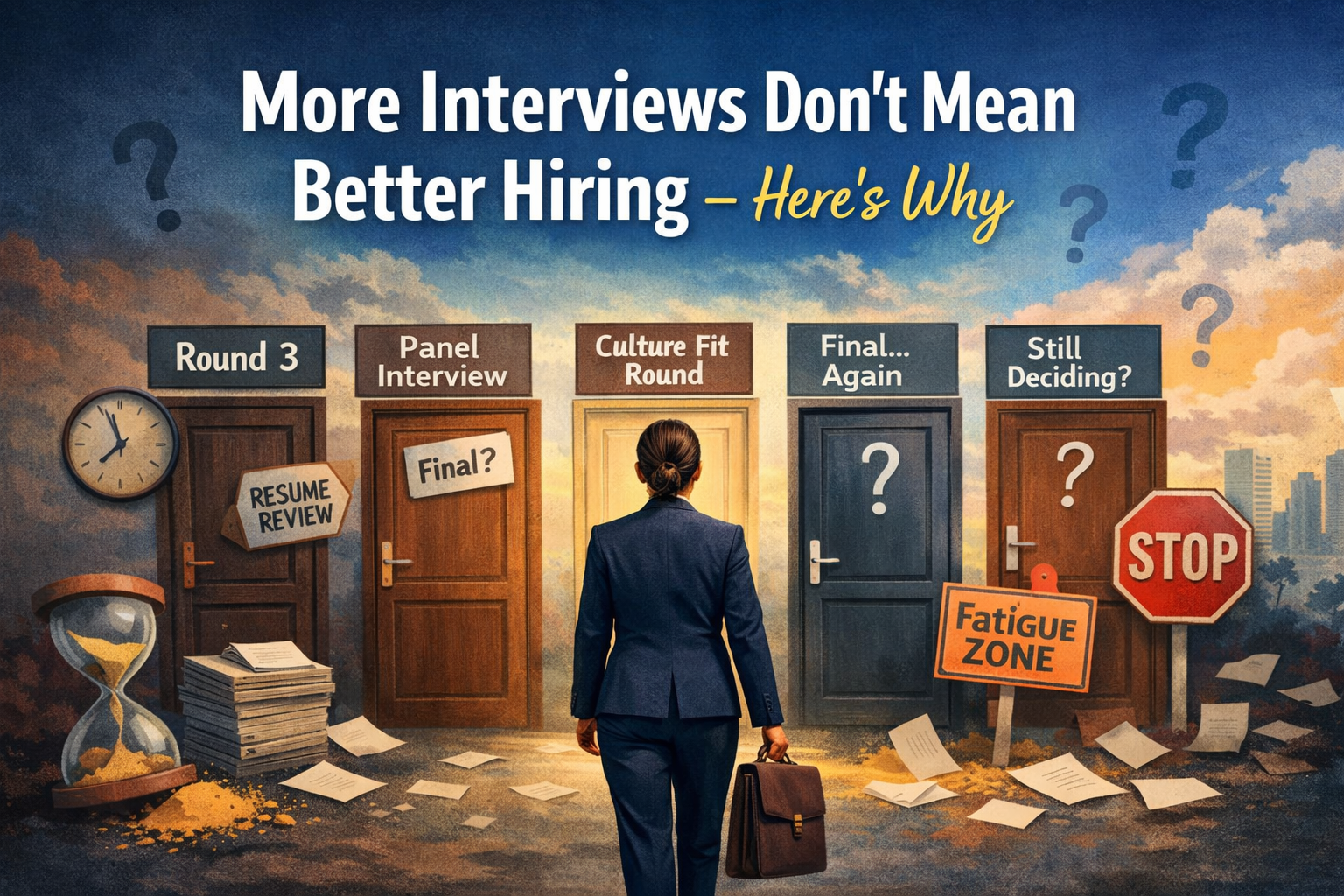
Somewhere along the way, hiring teams started believing that if two interviews are good, six must be brilliant. Add one more panel. One more leadership round. One more culture-fit chat. One more “final final” discussion. The result? Candidates feel like they are applying for citizenship, not a job. And employers still miss great hires.
The uncomfortable truth is this: more interviews do not automatically produce better hiring decisions. In many cases, they simply create slower decisions, interview fatigue, candidate drop-off, and the illusion of rigor.
If hiring quality really improved every time another person joined the panel, this might be worth it. But the evidence points elsewhere. The real differentiator is not the quantity of interviews. It is the quality, structure, and relevance of the signal you collect.
Interview inflation is real
Hiring teams are spending more time interviewing than they did just a few years ago. Gem’s 2025 Recruiting Benchmarks report found that hiring teams conducted 42% more interviews per hire in 2024 than in 2021, rising from 14 to 20. The same report linked that rise to a 24% increase in average time to hire, from 33 days to 41 days.
That sounds like rigor. But it often behaves like drag. In technical and product-heavy functions, the problem gets even worse. Gem reported that Product Management roles averaged 42 interviews per hire in 2024, while Engineering and Data Science roles averaged 39.
That is not a hiring process. That is an obstacle course with a calendar invite.
Candidates do not want marathon hiring processes
Employers may think more stages communicate selectiveness. Candidates often read them as indecision. Bartech’s 2025 candidate research, based on a survey of more than 550 engineering and professional services workers in North America, found that 63% of candidates preferred just two interview rounds. Another 23% would tolerate three. Fewer than 1% were willing to endure four or more stages.
That gap matters. When employers design for internal comfort instead of candidate reality, they lose momentum and they lose talent.
The market punishes slowness. Cronofy data cited by The HT Group found that 42% of candidates dropped out because interview scheduling took too long. And top candidates are often off the market in about 10 days, while average time to hire for many roles stretches well beyond that.
More interviews often create the illusion of better judgment
One of the biggest myths in hiring is that additional interviewers always add meaningful new signal. In reality, extra rounds often add duplicated questions, repeated impressions, and more opportunities for bias to creep in.
Google’s famous hiring analysis is useful here. As cited by multiple recruiting sources discussing Google’s “Rule of Four,” the company found that four interviews were enough to make a hiring decision with 86% confidence, and additional interviews added little incremental value. The lesson was simple: after a point, more interviewing does not meaningfully improve decision quality.
That idea should make every hiring team pause. If a world-class company obsessed with analytics concluded that more interview rounds had sharply diminishing returns, why are so many organizations still acting like the seventh round is where truth finally reveals itself?
Unstructured interviews are weaker than most employers assume
The deeper problem is not just interview count. It is interview design. A bloated process full of weak interviews is still a weak process.
Research summaries based on major selection meta-analyses consistently show that unstructured interviews are poor predictors of future job performance compared with stronger methods. eSkill’s 2025 review notes that a typical unstructured employment interview leads to the right hire only about 57% of the time and that structured interviews are substantially more predictive.
Why? Because unstructured interviews are often driven by vibes. Different candidates get different questions. Interviewers overweight charisma, familiarity, and first impressions. Everyone leaves the room feeling confident, but confidence is not the same as validity.
Crosschq’s data makes this point even more uncomfortable. Its research reported that only 9% of interview scores correlated with quality of hire, while 76% of interviewers conducted only one interview per year. That means many interviewers are making high-stakes talent decisions without enough repetition, calibration, or practice to be especially accurate.
Structured interviews beat endless interviews
The better path is not to keep adding rounds. It is to improve the signal in each round.
Structured interviews ask every candidate the same job-relevant questions and score responses against consistent criteria. Summaries of the Sackett-led meta-analytic work cited by both Alva and eSkill put the predictive validity of structured interviews around 0.42, making them materially stronger than unstructured interviews and traditional resume-based screening.
In plain English: four bad interviews are not better than two good ones. And two good structured interviews, combined with a relevant assessment or work sample, may outperform six rounds of improvisation.
Slow and messy hiring damages acceptance rates too
Interview inflation does not only affect productivity. It affects conversion.
CareerPlug’s 2023 Candidate Experience Report found that 49% of job seekers had declined an offer because of a poor candidate experience. Among the biggest reasons were slow and disorganized interviews and negative experiences with people in the interview process.
JobScore’s 2026 candidate experience roundup similarly reported that 53% of withdrawn candidates were pessimistic about the speed of the recruitment process, and 32% of North American candidates who withdrew said they accepted another offer elsewhere.
This is the irony of over-interviewing: companies often add rounds to avoid making the wrong hire, then lose the right hire because the process drags on too long.
What smarter hiring actually looks like
Better hiring is not about speed alone. It is about disciplined signal collection.
A smarter process usually includes fewer stages, clearer ownership, structured scoring, trained interviewers, and role-relevant assessments. It removes duplicate rounds. It stops asking five different people to evaluate the same competency in five slightly different ways. It tells candidates what to expect. And it moves fast enough to be credible.
If one interview checks problem-solving, another checks collaboration, and a work sample checks actual ability to do the job, the process becomes sharper. If round six is just another executive “gut check,” it is probably decorative, not diagnostic.
The real hiring upgrade
The strongest hiring teams are not the ones with the most interview rounds. They are the ones that know exactly why each stage exists.
That is the shift the market now requires: from interview volume to interview intelligence. From more opinions to better evidence. From process theater to actual hiring quality.
So the next time someone says, “Let’s add one more round just to be safe,” the better question is this: what new signal are we collecting that we do not already have?
If there is no clear answer, it is probably not better hiring. It is just more interviewing.
Conclusion
More interviews do not automatically produce better hires. The evidence shows that interview-heavy processes increase time to hire, frustrate candidates, and often add less predictive value than hiring teams assume. Employers do not need more rounds. They need better-designed ones. Structured interviews, relevant assessments, clear ownership, and respect for candidate time will outperform interview bloat almost every time.
Want to improve hiring quality without slowing your team down? HireSutra helps organizations build faster, sharper, and more evidence-based hiring processes.