Hiring a senior leader is one of the most expensive and consequential decisions an organisation makes. Yet the first year in a leadership role is often where things begin to unravel. The problem usually is not capability on paper. It is misfit in context.
Many organisations assume that a strong track record, executive presence, and an impressive interview are enough. But leadership success depends on far more than credentials. It depends on culture, timing, stakeholder alignment, clarity of mandate, and support after the offer letter is signed.
The Failure Rate Is Higher Than Most Companies Admit
Multiple leadership and hiring studies suggest that a large share of senior hires fail within the first 12 to 18 months. Some sources place executive failure in the 40% to 50% range, while broader hiring research has found that 46% of new hires fail within 18 months. In some first-time sales leadership situations, the failure rate within 12 months is reported to be even higher.
This is not just a hiring problem. It is a business risk problem. When a leadership hire fails, the company loses time, money, momentum, and often team confidence.
Why Leadership Hires Fail So Early
1. The Role Was Never Clearly Defined
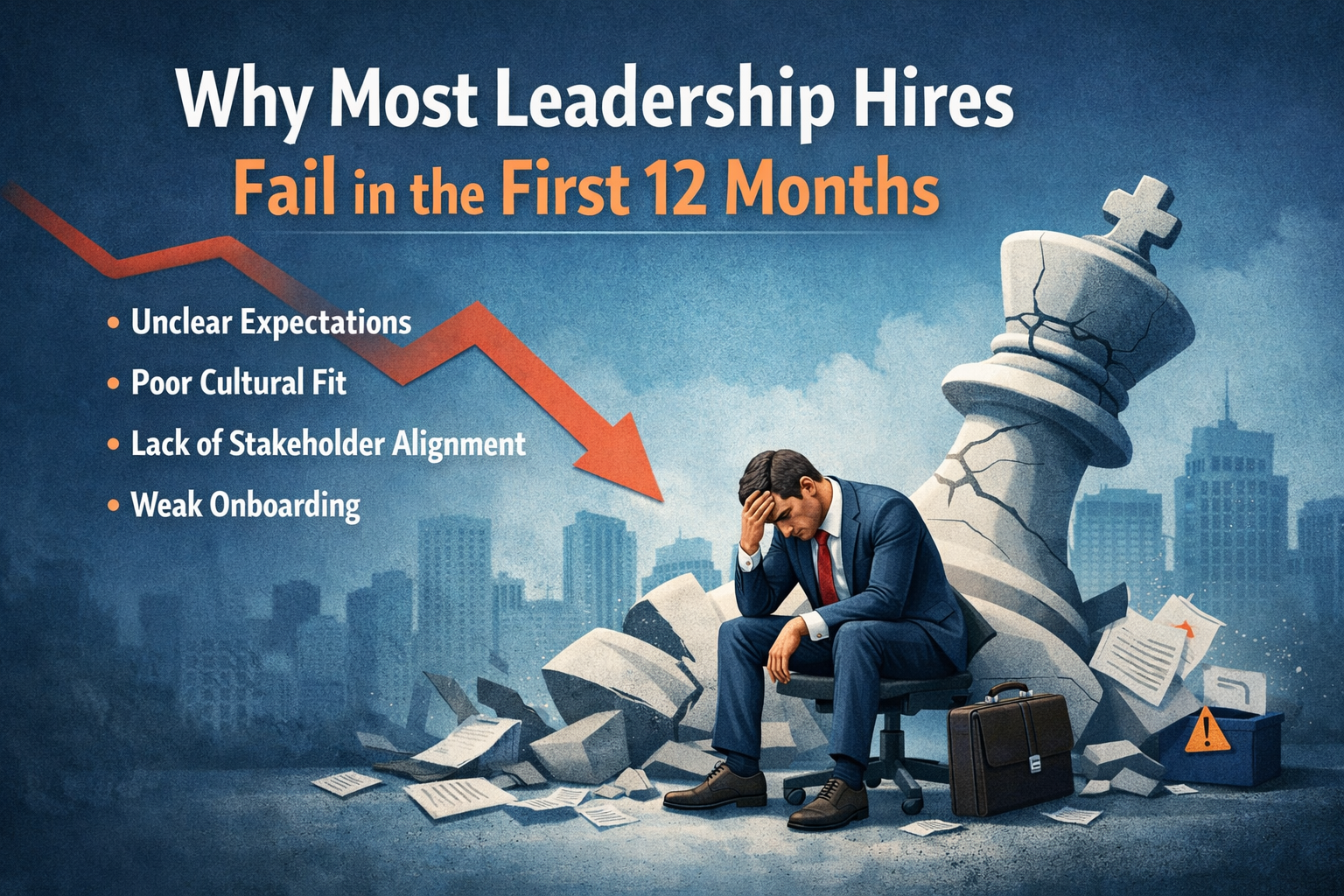
Many leadership searches begin with a title, a broad job description, and a list of ideal experiences. But that is not the same as defining what success actually looks like. What must this person fix, build, or scale in the first 12 months? Which stakeholders matter most? What trade-offs will they need to manage? If these answers are vague, the search starts on weak foundations.
Leadership hires often fail because organisations hire for pedigree instead of fit-for-mission. A leader who succeeded in one company, stage, or market may fail in another because the demands are fundamentally different.
2. Companies Overvalue Charisma and Undervalue Context
Executive interviews can be misleading. Strong communicators often create confidence quickly, but confidence is not the same as judgment. Companies frequently over-index on polish, titles, and past employer brands while under-testing how the candidate will operate in the reality of the new role.
Leadership success is contextual. A leader who thrived in a fast-moving startup may struggle inside a matrixed enterprise. A functional expert may underperform in a role that requires influence across the board, peers, and multiple teams.
3. Cultural Fit Is Treated as a Soft Issue
Culture is often discussed late in the process, and usually in superficial terms. But many leadership failures happen because the leader cannot read the organisation’s norms, decision-making style, power centres, or informal networks. Technical skill rarely causes the collapse on its own.
Studies frequently cited in hiring research show that new-hire failure is driven far more by coachability, emotional intelligence, motivation, and cultural alignment than by lack of technical competence. At senior levels, this matters even more because leaders shape teams, not just tasks.
4. Stakeholder Relationships Are Built Too Late
New leaders need credibility before they can drive change. When they fail to build trust quickly with peers, direct reports, founders, or board members, their authority weakens. Even capable leaders begin to look ineffective when they lack political support and informal influence.
Research and executive transition writing consistently point to poor relationship-building as one of the most common reasons new leaders fail.
5. Onboarding Is Too Short for a Senior Role
Most organisations treat onboarding as an HR event. For leadership hires, it should be a strategic transition program. A new vice president, business head, or CXO is not simply joining the company. They are stepping into a system of expectations, history, politics, and pressure.
Leadership onboarding should extend well beyond the first week. Effective programs often include stakeholder mapping, 30-60-90 day priorities, regular check-ins, coaching, early-win planning, and clear feedback loops. Without this support, the leader spends the first year guessing instead of leading.
6. The Business Wants Transformation but Resists Change
This is one of the most overlooked causes of leadership failure. Companies say they want a change-maker, but in practice they often punish anyone who disrupts established patterns too quickly. Founders want delegation but struggle to let go. Boards want speed but do not align internally. Teams want direction but resist new methods.
In these cases, the failure is not only the leader’s. It is a mismatch between the mandate sold during hiring and the environment the leader actually inherits.
What Leadership Hiring Teams Should Do Differently
Define success in 12-month terms
Before opening the search, define what success looks like by month 3, month 6, and month 12. Make the mandate concrete. Revenue growth, team rebuilding, process discipline, market expansion, or culture repair are very different leadership challenges.
Assess for judgment, not just biography
Use scenario-based assessments, problem-solving discussions, stakeholder simulations, and reference checks that explore setbacks as much as wins. A resume tells you where someone has been. It does not tell you how they will lead in unfamiliar terrain.
Evaluate cultural and behavioural fit with rigor
Treat culture and leadership style as measurable selection criteria, not informal impressions. Coachability, humility, adaptability, emotional range, and ability to influence across functions should be tested deliberately.
Build a real leadership onboarding program
For senior hires, onboarding should be structured, long-horizon, and business-linked. Include alignment meetings, role clarification, board or founder expectations, peer relationship planning, and executive coaching where needed.
Hold the organisation accountable too
A leadership hire should not carry the full burden of transition alone. The hiring manager, board, founder, and HR team all shape the outcome. If the company is unclear, politically fragmented, or resistant to the very change it hired for, even a strong leader can fail.
Conclusion
Most leadership hires do not fail because they fooled the interview panel. They fail because organisations confuse credentials with fit, momentum with readiness, and recruitment with transition. The first 12 months expose every weakness in the hiring process: unclear role design, shallow assessment, poor onboarding, and weak alignment.
The companies that get leadership hiring right are the ones that define success clearly, assess leaders in context, support them aggressively after joining, and take shared ownership for the outcome. Great leadership hires are not just selected well. They are set up well.