Hiring teams often obsess over interview performance, offer acceptance rates, and onboarding success. But there’s a deeper, less visible problem: your best candidates never apply in the first place.
Not because they’re uninterested—but because your hiring process silently filters them out before they even enter the funnel.
The Hidden Reality of Talent Markets
Around 70% of professionals are passive candidates—not actively applying but open to opportunities, while only 30% are actively job hunting. This means that if your hiring strategy depends on inbound applications, you're automatically ignoring most of the talent market.
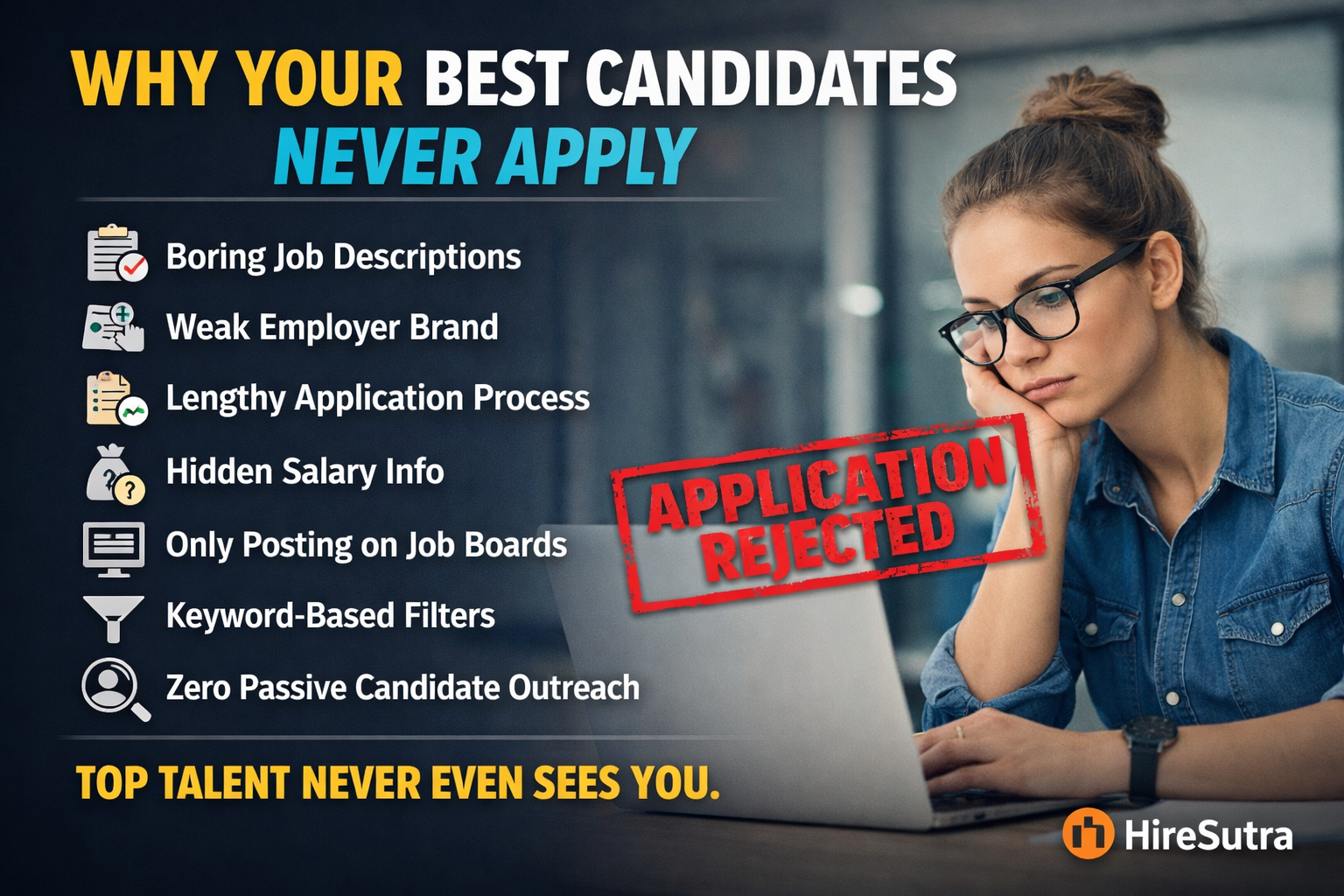
Your Job Descriptions Repel High Performers
Most job descriptions are overloaded with requirements, focused on years of experience instead of impact, and filled with generic phrases. High-quality candidates often self-filter out if they don’t meet 100% of requirements.
Research shows men apply when they meet around 60% of criteria, while women apply only when they meet nearly 100%, unintentionally filtering out strong and diverse talent.
Your Employer Brand Isn’t Convincing
Top candidates research companies before applying. They evaluate leadership, employee reviews, product quality, and culture signals. If your digital presence is weak or inconsistent, they drop off silently.
75% of job seekers consider an employer’s brand before applying, making brand perception a critical factor in attracting top talent.
Your Hiring Process Signals Friction
Long application forms, mandatory cover letters, unclear timelines, and lack of salary transparency create friction. High performers, who often have multiple options, opt out instantly.
Studies show that 60% of candidates abandon applications due to length or complexity.
You’re Fishing Only in Active Channels
Job portals primarily attract active job seekers, but top candidates are usually employed and not actively browsing. Limiting hiring strategy to job postings means missing out on high-quality passive talent.
You’re Not Using Intelligence, Just Volume
Most hiring systems rely on keyword filtering and manual shortlisting. However, top candidates optimize for impact, not keywords, leading to a mismatch where average candidates pass filters and exceptional candidates get missed.
Compensation and Transparency Gaps
Top candidates expect clear compensation, growth paths, and honest expectations. Job postings without salary transparency often get ignored or assumed to be below market.
Research shows that job postings with salary ranges receive significantly more applicants.
You’re Not Solving for Candidate Psychology
Top candidates evaluate roles based on career acceleration, leadership credibility, and impact. Traditional job descriptions fail to address these factors, leading to disengagement before application.
What High-Performing Companies Do Differently
- Rewrite job descriptions as opportunity narratives focused on impact
- Build strong employer branding through authentic content and leadership visibility
- Simplify application experience with minimal friction
- Adopt proactive sourcing instead of relying only on inbound applications
- Use AI and structured evaluation for better candidate matching
The Shift: From Applicants to Talent
Winning companies are shifting from asking how to get more applicants to how to reach the right candidates before they apply. This transition from application-driven hiring to intelligence-driven hiring is critical for success.
Conclusion
If your best candidates aren’t applying, it’s not a talent shortage problem—it’s a signal problem. Your hiring system is either sending the wrong signals or not reaching the right people.
The best candidates don’t apply. They are attracted—or they are found.