Introduction
India's technology sector is growing rapidly. Global capability centres (GCCs) and domestic startups have added hundreds of thousands of jobs, and the government promotes digital public-infrastructure and artificial-intelligence (AI) initiatives. Yet recruiters routinely warn that hiring technical talent is harder than ever. In 2025 India produced around 1.5 million engineering graduates, but only about 45% meet industry standards, and staffing firms estimate that fewer than 10% of graduates secure jobs in their core field. Similar studies find that only 42–55% of graduates are employable.
Demand for specialists in artificial intelligence, cybersecurity, cloud computing and data engineering exceeds supply, and the mismatch is exacerbated by high attrition and the relocation of work to smaller cities. The purpose of this article is to synthesise current research and news (as of March 2026) on the recruitment challenges faced by companies hiring technical talent in India and to analyse how AI can help address them.
India's Technical Talent Landscape
A Growing Talent Pool With Limited Employability
India is a global hub for technology talent, producing more engineers annually than the United States or most European countries. However, several studies underline a sizeable skills gap. The staffing firm TeamLease reports that about 45% of India's engineering graduates meet industry standards. An analysis by Mercer–Mettl finds that only 42.6% of graduates are employable, down from 44.3% in 2023. India's gig workforce already exceeds 12 million and is projected to surpass 23 million by 2030, reflecting a shift towards project-based hiring and flexible work. Global capability centres alone employ nearly 2 million people and contributed US $64 billion in revenue by 2024.
Demand for Niche Skills and Rising Competition
Several sectors – particularly software development, fintech, e-commerce and AI – face acute shortages of niche skills. Research from Alp Consulting estimates a 45% talent deficit in areas such as artificial intelligence, cybersecurity and data engineering. India's Global Capability Centres report that senior roles (e.g., architects, staff engineers, AI practitioners) are bottlenecks even as junior hiring is flat.
- 45% talent deficit in AI, cybersecurity and data engineering
- GCCs report bottlenecks for senior architects and AI practitioners
- Fintech firms cite skill shortages, high attrition and competition from global tech firms
- Competitive compensation and aggressive hiring by MNCs drive salary inflation
- Domestic firms and startups struggle to attract experienced talent
Attrition and Retention Challenges
Attrition remains high despite recent declines. Aon's annual salary and turnover survey reports that overall attrition fell to 16.2% in 2025, down from 17.7% in 2024 and 18.7% in 2023. While this signals a return to pre-pandemic stability, about 75% of attrition remains voluntary – employees leaving for better opportunities. Sectoral differences are pronounced: e-commerce attrition can exceed 25%, whereas GCCs operate at around 12.6%.
High attrition imposes replacement costs and slows projects. Remote and hybrid working arrangements help mitigate turnover; one study notes that remote work can reduce turnover by 25–30%. However, attrition also reflects intense competition for skilled workers and underscores the need for effective retention strategies.
Geographic and Structural Shifts
Recruitment is spreading beyond metropolitan hubs. Tier-2 and tier-3 cities such as Coimbatore, Indore and Nagpur recorded 20–40% growth in IT hiring in 2025, compared with 12–15% growth in Tier-I cities. GCCs and IT firms are expanding to these cities to tap local talent, aided by improvements in digital infrastructure and hybrid work models. At the same time, project-based hiring has grown nearly 40%, and many firms are shifting to gig-oriented talent models.
Key Recruitment Challenges for Technical Talent
- Skills gap and employability — Only 45% of engineering graduates meet industry standards; about 42–55% are employable; graduates lack practical exposure and soft skills
- Talent scarcity in niche skills — 45% deficit in AI, cybersecurity and data engineering; GCCs report senior-role bottlenecks
- Volume–quality mismatch — 53% of recruiters say AI-generated applications make hiring harder; 48% struggle to distinguish authentic profiles; applications per vacancy have doubled since 2022
- Lengthy hiring cycles — Prolonged screening due to large applicant volumes; time-honoured processes unable to scale
- High attrition and competition — 16.2% overall attrition; 75% voluntary; IT at ~25%, e-commerce up to 28.7%; salary increments averaging 9% fuel job-hopping
- Geographic challenges — Tier-2/3 cities report 20–40% growth in IT hiring; firms must invest in infrastructure; remote/hybrid work complicates culture and onboarding
- Employer branding and diversity gaps — Poor employer branding and lack of inclusive policies as barriers; DEI initiatives becoming strategic priorities
These challenges interact. A large talent pool can mask employability gaps; competition for scarce skills inflates salaries and accelerates attrition, and the proliferation of AI-generated résumés overwhelms recruiters. Recruiters must sift through numerous profiles while ensuring diversity and fairness, all while working within compressed hiring timelines.
How AI Is Transforming Recruitment in India
Near-Universal Adoption of AI Tools
Indian organisations have embraced AI in recruitment more rapidly than most other countries. Indeed's 2025 Smarter Hiring Report finds that 95% of Indian employers already use AI-powered hiring tools, whereas only 5% do not. By comparison, only 75% of U.S. firms and 66% of U.K. firms use such tools.
- 46% of employers use AI for automated talent sourcing and screening
- 41% automate interview scheduling and candidate communication
- 38% use AI to summarise candidate profiles and assess role fit
- 92% of job seekers use AI tools — for interview preparation (42%), CV optimisation (36%) and other purposes
- 71% of recruiters say AI provides deeper insight into candidate skills; 76% say it accelerates hiring
Despite broad adoption, the AI hiring paradox persists: 53% of recruiters blame the rise of AI-generated applications for making talent harder to find, and 48% struggle to distinguish authentic profiles from low-quality or misleading statements. Hence, AI is both a problem and a solution.
1. Skill-Centric Screening and Shortlisting
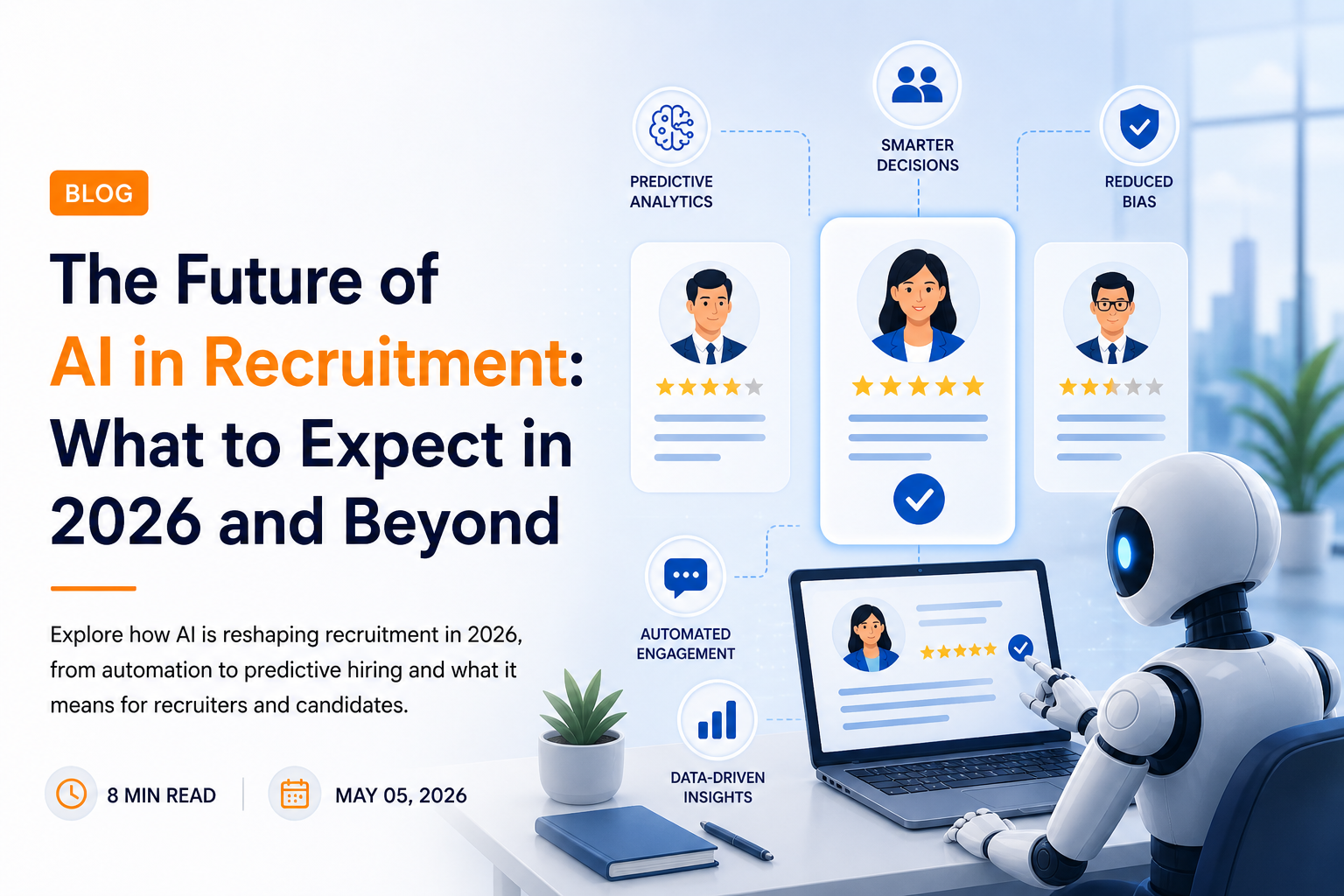
AI-powered applicant tracking systems (ATS) and resume-parsing tools analyse thousands of résumés to identify candidates whose skills and experience align with job requirements. By focusing on capabilities rather than credentials, AI encourages skills-first hiring. Predictive analytics can also estimate a candidate's likelihood of success or attrition, enabling recruiters to prioritise high-potential applicants.
2. Automated Assessments and Scheduling
AI enables virtual coding tests, simulations and psychometric assessments that assess practical competencies and soft skills at scale. Chatbots handle initial screening questions and schedule interviews, reducing administrative burden. In India, 41% of employers automate interview scheduling and candidate communication. This shortens time-to-hire and improves candidate experience.
3. Bias Mitigation and Diversity
By removing identifying information and focusing on skill data, AI can help reduce unconscious bias in hiring. However, AI models need continual auditing to avoid reproducing biases present in training data. Candidates and regulators increasingly demand transparency about how AI tools make decisions. Recruiters must therefore balance efficiency gains with ethical considerations.
4. Workforce Planning and Retention Analytics
AI is not limited to sourcing; it also enables predictive workforce analytics. By analysing historical attrition patterns, skill inventories and project needs, AI can forecast future skill shortages and inform training investments. Organisations can design internal mobility programmes and targeted upskilling to retain high-potential employees. Business leaders note that voluntary attrition has eased to 12% in part due to better alignment of internal mobility and capability building.
5. Enhancing Employer Branding and Candidate Experience
Personalised AI chatbots and recommendation engines provide candidates with real-time updates and feedback, improving transparency and engagement. AI can also monitor employer-brand sentiment across digital channels and highlight areas where communication or inclusivity needs improvement. With skills-based hiring becoming mainstream, AI helps organisations showcase learning opportunities and career trajectories, which attract candidates seeking growth.
Balancing AI With Human Judgement
While AI automates repetitive tasks and improves efficiency, it cannot replace human judgement. LinkedIn survey data reports that 71% of recruiters say AI uncovers hidden talent, 80% say it provides better insight into skills, and 76% say it speeds up hiring. Yet recruiters also emphasise that cultural fit, leadership potential and soft skills must be assessed by humans. The most successful strategies use AI for administrative efficiency and unbiased screening while reserving final decisions for experienced recruiters.
Addressing Recruitment Challenges Through AI
Bridging the Skills Gap
AI cannot replace foundational education and training, but it can help organisations identify transferable skills and potential in candidates who may lack formal credentials. Skill-based assessments and coding challenges reduce reliance on degrees and test real-world abilities. Employers can also use AI-driven learning platforms to deliver customised upskilling programmes, aligning workforce capabilities with emergent technologies.
Streamlining Screening and Reducing Noise
The flood of AI-generated résumés makes manual screening infeasible. AI-enabled ATS can filter out near-duplicate or machine-generated applications and surface candidates with relevant skills. Natural-language processing can detect semantic alignment between job descriptions and candidate profiles, reducing reliance on keyword matching. However, recruiters must guard against over-reliance on AI; periodic audits, bias checks and human review are essential.
Combating Attrition and Improving Retention
Predictive analytics can flag employees at risk of leaving by examining factors such as compensation, promotion history, engagement scores and skill progression. Companies can then offer tailored retention incentives or career development opportunities. AI-driven internal talent marketplaces match employees to new projects based on their skills and learning goals. By shifting from volume hiring to value density per hire, organisations reduce attrition and build long-term capability.
Expanding the Talent Pool Geographically
Remote and hybrid work models open access to talent in tier-2 and tier-3 cities. AI facilitates virtual interviews, digital onboarding and remote collaboration, making it feasible to hire from regions previously overlooked. AI-based language translation and sentiment analysis support inclusive recruitment across languages and cultures. By combining AI with investments in digital infrastructure and community-based training, firms can tap into a wider talent pool.
Ethical Considerations and Transparency
AI's effectiveness depends on data quality and algorithm design. Recruiters must ensure that AI tools comply with privacy laws and fairness guidelines. Candidate consent and clear communication about how AI influences hiring decisions are essential. Nearly half of Indian recruiters feel pressure to justify AI use, reflecting growing scrutiny from candidates and regulators. A balanced approach – using AI to augment rather than replace human judgement – fosters trust and supports inclusive hiring.
Conclusion
India's technology sector in 2026 is characterised by rapid growth, ambitious digital-transformation agendas and an unprecedented demand for specialised talent. Despite producing millions of graduates, the country confronts a persistent skills gap, niche-skill shortages, high attrition and a volume–quality mismatch exacerbated by AI-generated applications. Employers also navigate geographic expansion into tier-2 and tier-3 cities, rising salary expectations and the need to strengthen employer branding and diversity initiatives.
“AI has emerged as both a culprit and an ally. With 95% of employers using AI tools and 92% of candidates engaging with AI, the most successful strategies use technology for administrative efficiency and unbiased screening while reserving final decisions for experienced recruiters.
— Industry Analysis
Going forward, organisations must invest in skills-first hiring models, robust internal talent pipelines and ethical AI governance. Collaboration between industry, academia and government is needed to update curricula and support apprenticeships. By integrating AI thoughtfully and prioritising human judgement, Indian companies can overcome recruitment challenges, close the skills gap and build a diverse, resilient and innovative technical workforce.
References
Reports employability rates of Indian graduates and skill readiness.
Annual report analysing employability across engineering and technical graduates.
Provides statistics on employability and workforce readiness in India.
Reports 45% talent deficit in AI, cybersecurity and data engineering.
Forecasts demand for emerging skills such as AI, cloud and cybersecurity.
Reports 16.2% attrition rate in 2025 and workforce mobility trends.
Data showing rising recruitment in cities beyond metro hubs.
Reports recruiter perspectives on AI, including increased application volume and screening challenges.
Discusses how AI tools impact hiring processes and candidate experience.
Research on digital skills demand and workforce transitions.